


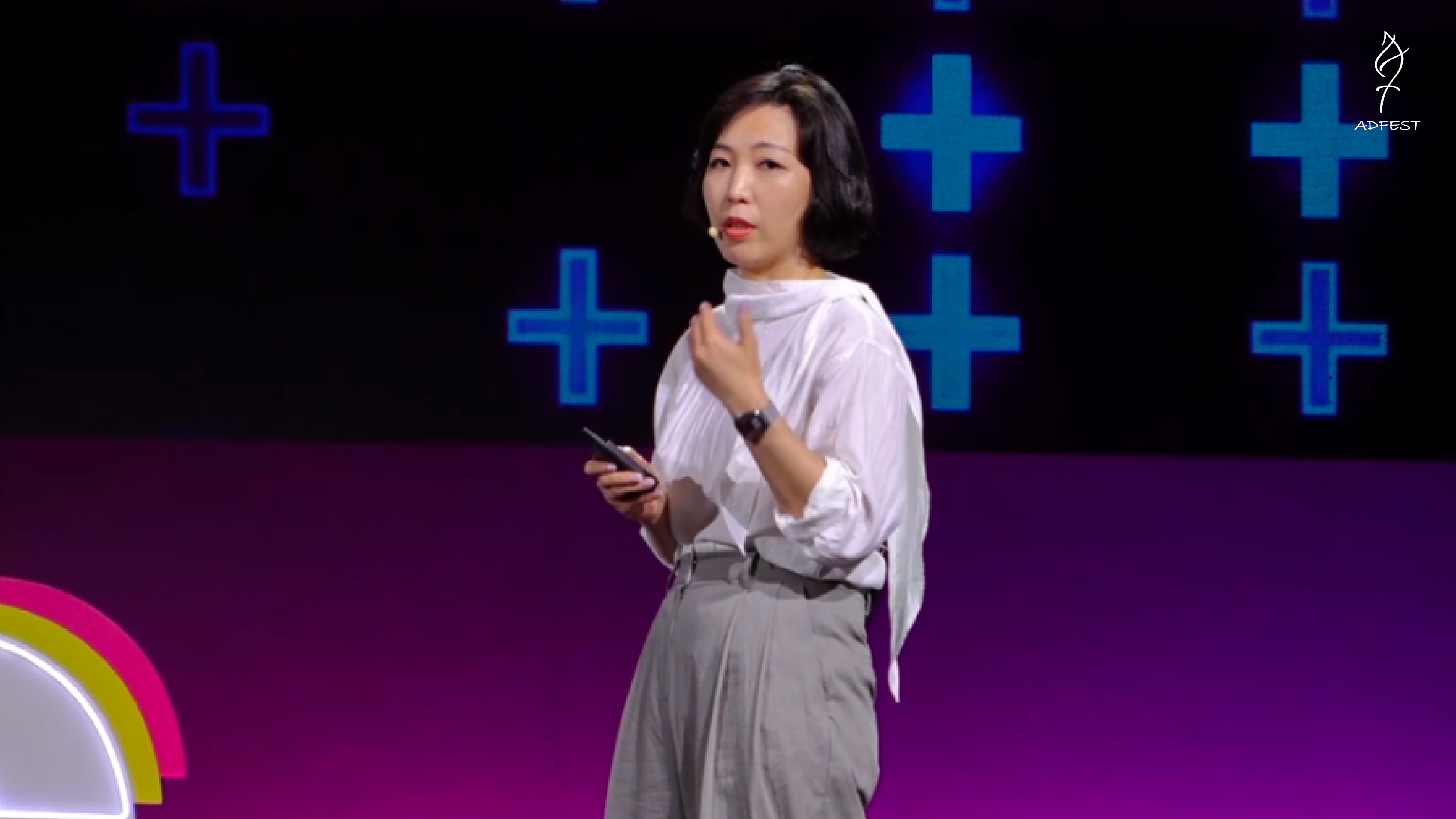
At ADFEST 2026, Joohee Lee, Creative Director at Cheil Korea in Seoul, presented "A Global Brand's Challenge Beyond Borders." Drawing on her work for Samsung and BTS, she examined how creative work stays human when it has to travel across more than 200 countries.
Korea now exports culture as well as technology — K-food, K-beauty, K-pop and K-drama, or what Lee called K-everything. Korean brands have been global for a long time, but their recognition and sales scale are far larger now, and they create synergy with each other, which is why a collaboration between K-pop Demon Hunters and Samsung Galaxy can operate on a global scale.
To understand “beyond borders”, Lee highlights two opposing worlds:
Domestic: Local ads for Locals with the same language and culture. Trends, wordplay and celebrity all work, and everyone gets the joke.
Global: Global ads for the World with one campaign across over 200 countries. Every market flags a risk, the idea gets cut down, and what is left is often just the product on screen.
Local work has more creative freedom and is more likely to resonate. Global work; on the other hand, has more creative limitations and is more likely to be safe. That tension, Lee said, is what global creatives live with every day. To bridge this gap, global campaigns must focus on shared human elements rather than generic features. Lee asserted that staying human beyond borders is the key to overcoming challenges beyond them.
She illustrated this with two very different projects that navigated beyond borders.
Samsung: when the brief is all specifications. When Samsung was still building awareness, the goal allowed for works like “Look at Me,” a project for children with autism that won several awards including a Gold at ADFEST. Now that brand awareness is very high, the goal has moved to sales and loyalty, with more emphasis on key features and function for brand consistency. The brief for the Galaxy Book 6 Pro was exactly that: a three-minute launch film for media and technology press, covering every feature of a new laptop.
People-led storytelling in “Engineered for Perfection” was Cheil's answer. Rather than listing specifications, they told the human story of the team behind the device. By spotlighting the engineers, designers, and their zero-compromise craft, the film drove high engagement, positive sentiment, and strong software sales without relying on generic features. The film is long and technical, and the response still surprised the team: comments about technology meeting beauty, and about there being no AI in it. Engagement was strong, and the film supported sales and press coverage.
BTS: a campaign colour with a political problem. For the comeback, Cheil was asked to turn Seoul into a festival space under the name BTS The City Arirang. The album's colour was red, and Cheil named the shade Ari-Red, with the campaign built to turn the city that colour. But red is the colour of a major political party in Korea, and a general election was approaching, so the campaign had to avoid unintended political associations. That was the first border.
The second was a historical border. BTS's comeback was being treated as a national cultural moment, and the Korean government and Seoul city asked Cheil to project a light show onto Sungnyemun Gate, National Treasure Number One. It was the first time the gate had been given to a music group for a facade show. But two conditions came attached: the show had to highlight the gate's history and architectural beauty, and no human faces were allowed.
The team had to navigate through invisible political, cultural, and artistic borders, while also managing fan expectations. Cheil came up with a solution that told the story of Sungnyemun’s history and architectural beauty withBTS members only portrayed as silhouettes through the Seoul night. While red was used,, its use was restrained, appearing only at key moments and never dominated. In this case, staying human meant respecting the politics, history, and culture, while still letting K-culture speak to the world.
For Lee, working beyond the borders comes down to four things.
See the invisible borders: the political, cultural, governmental, artistic and fan realities nobody writes into the brief.
Respect both sides: the global brand's requirements and the local audience's context.
Honour all constraints: treat the borders as the parameters of the idea.
Stay human: hold to it even when the borders feel impossible.
The key takeaways from these projects:
Samsung: simplicity and authenticity scale
Ari-Red: emotion and local expression scale
The Sungnyemun BTS Facade Show: deepest creativity happens where several borders or constraints intersect
This is not about making cool creative, Lee said. It is about intelligently navigating visible and invisible borders with respect for the product and the audience, while also driving real business. We don't control the borders, but we control how we respond to them. And we should do so with pride.