

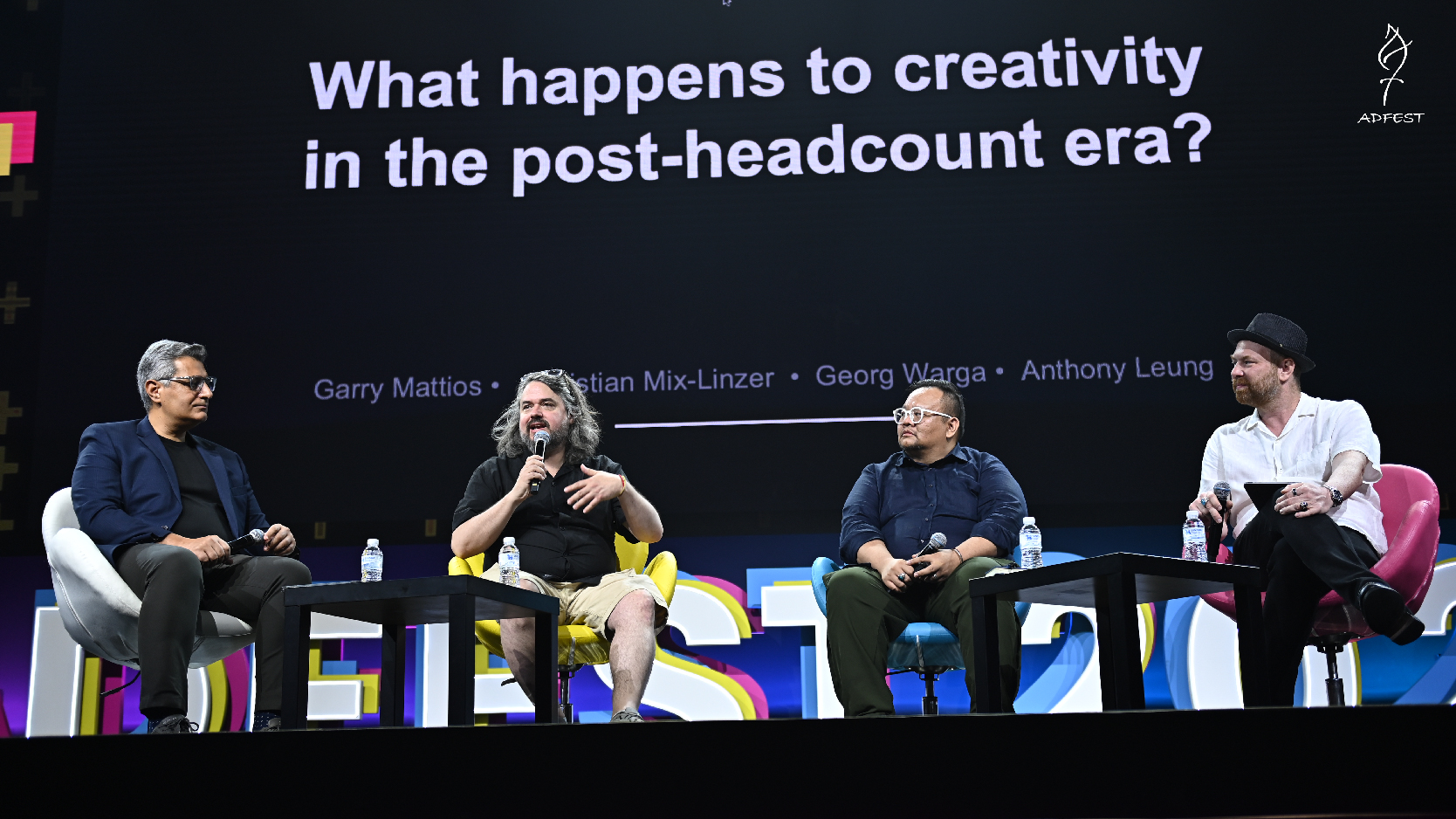
At ADFEST 2026, Christian Mix-Linzer, CEO of Tracks & Fields, headed the panel “Creativity After the Headcount Era” with Georg Warga, Founder and Creative Director of GOODSTEIN and Chief Creative Officer of The Tamashi Collective; Anthony Leung, Founder and CEO of The Tamashi Collective; and Gerry Mattios, Partner at Bain & Company.
Warga opened with a story from his years at a network agency, when a client walked in with a spreadsheet, literally counted the team, and demanded a refund for the 2 missing heads . That was the headcount era in one scene: creative value measured by people, hours, and the size of the team.
Gone are the days of body count as AI automation allows execution at scale, shifting the metric from hours to value and impact.
Mattios shared his perspective from the client side on how that shift takes shape in three broad archetypes:
The Inhousers: who invest in AI heavily, bring the creative work in-house and leverage AI automations. They are a small percentage, and the results so far are mixed.
The Experimenters: who leverage AI by automating selected parts of the marketing process and see what value can be created. Most of the clients are experimenters.
The Deniers: who wait-and-see and prioritise leveraging AI automations in other functions such as finance or supply chain over marketing.
So what is the creative outlook after the headcount era? The panel circled around several answers.
Impact beyond campaigns. Creativity is no longer only a service function producing assets. As Leung framed it, it can affect the whole business: brand, operations, systems, customer experience, and how organisations move. With fewer hours to sell, Mix-Linzer argued, value has to be measured and explained differently.
A visible way of working. A big network once carried its own proof through reputation, scale, and history. Smaller and newer teams have to earn trust through one job, prove the value, and build from there. In one procurement example, a major UK advertiser asked agencies to show exactly how they were using AI tools. The question was not whether they could claim efficiency, but whether the technology was meaningfully changing how the work was made.
A better use of people’s time. AI should not only be a headcount conversation. The sharper question is whether automation can take manual tasks off people’s hands and give people more time for thinking, judgment, and higher-value work. Mattios pushed this into a “what if” question: what if AI is used not simply to reduce teams, but to reimagine how work is done, how time is used, where resources go, and what broader work becomes possible?
Scale with judgment. Volume still needs scale. Mercedes-Benz, for example, needs campaigns with large numbers of assets, adaptations, and localisations, the kind of work that still benefits from large, diverse teams. But production can now scale down as well. Warga had recently run a campaign across APAC with a small team, producing assets across multiple platforms with a confidence he would not have had a year earlier. Small teams can carry more production weight, but creativity itself does not scale in the same way. In uncharted work, where the outcome is unclear, human judgment is paramount.
That judgment can push creative value beyond campaign output. A global EV launch in China had fallen months behind schedule and escalated to the global CEO. Leung’s team treated the brand as an operating system, aligned stakeholders, translated the global vision into a China-localised language, and reorganised the work across software, marketing, and customer experience. Within three weeks, they were presenting to the board. The value was not just in making assets, but in helping the organisation move.
Knowledge that can travel. Brand knowledge becomes another part of the value equation after the headcount era. Warga spoke about years of writing institutional knowledge into brand guidelines that end up unread on a server. LLMs may offer another way to hold that knowledge and pass it from one project, team, or person to the next. Zalando offers another model: the European fashion retailer changes agency for nearly every seasonal campaign, working with agencies such as Wieden+Kennedy, Mother, Jung von Matt, Anomaly, and 72andSunny, while an in-house team of around twelve producers and creatives briefs those agencies and holds the brand knowledge internally.
Human judgment. What remains valuable is not simply manpower, but the knowledge people carry. Warga argued for more seniority in creative teams, meaning knowledge, references, and lived experience, not age. Mix-Linzer described a similar shift in music recommendations for brands, where taste can now be informed by data: where an artist resonates, which audiences respond, and where relevance appears across markets. Leung closed on the human side of the reset: a chance to let go of old habits and build something new from experience, passion, and self-awareness. Business, as he put it, is your soul at work.
When headcount and hours can no longer explain creative value, the proof has to come from somewhere else: what the work solves, what it changes, and whether that value can be shown. After the headcount era, the question may no longer be how many people worked on it, but what creativity can now prove.