


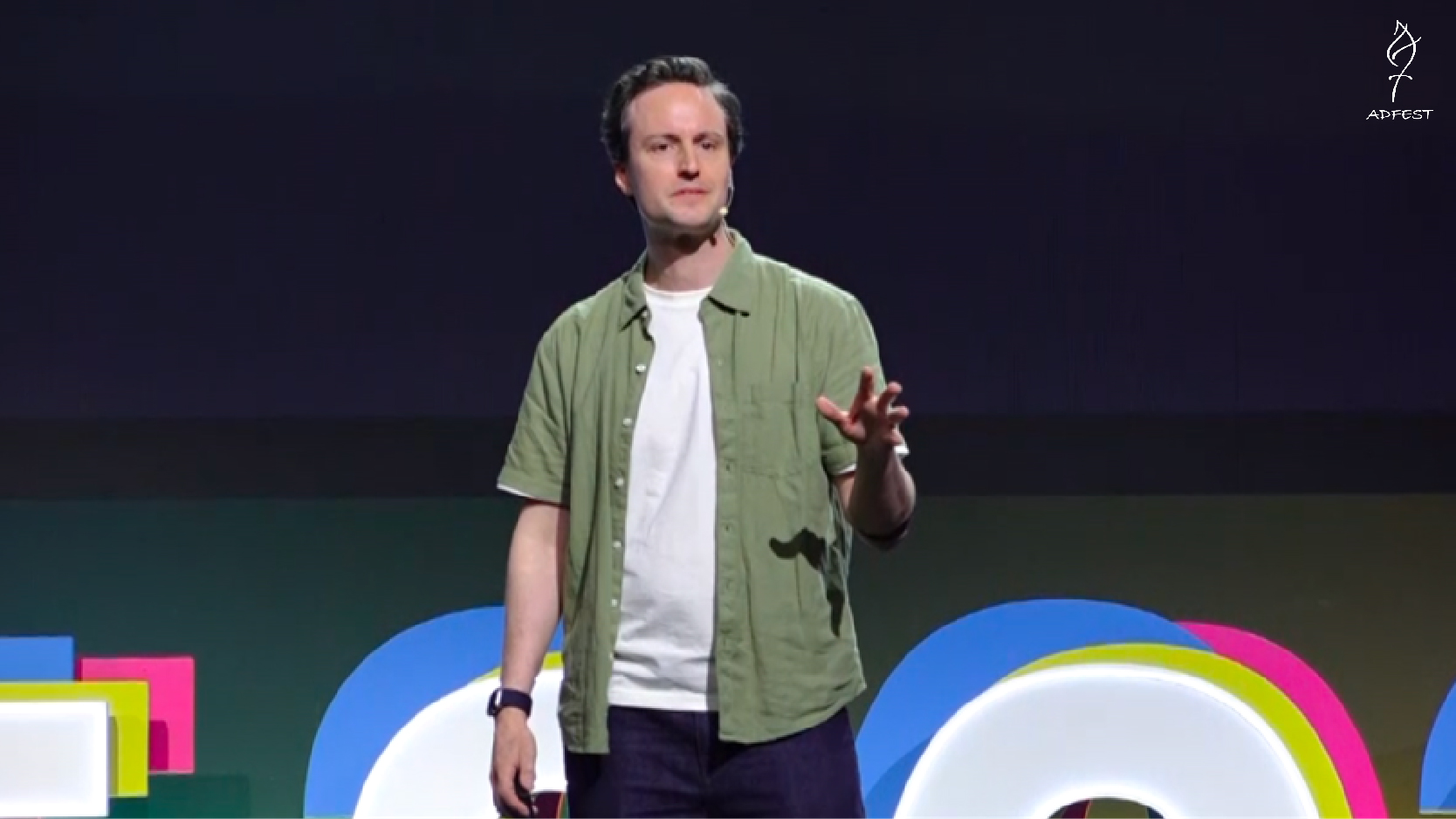
At ADFEST 2026, Oliver Atkinson, Director of Narrative Strategy at Casual, presented "Making People Care: Storytelling in the Age of AI". He asserted that in an era of infinite AI-generated content, the primary scarcity is no longer execution but genuine human connection. Casual has spent two years on a strategic pivot fusing storytelling, technology, and behavioural insight to address audience indifference.
Atkinson noted that most ads fail simply because they go completely unprocessed by the subconscious brain, filtered out by a “mental ad blocker,” the reticular activating system acting as a cognitive bouncer. To bypass this barrier, creative work must shift toward two metrics:
Resonance: the preliminary pass, where contextual cues and tone align with the audience's specific identity. It is the “way in” to get by the bouncer.
Immersion: the critical threshold where the audience transitions from scanning to active experiencing. It is what keeps them there. He aptly summed it up as the “give a sh*t” metric.
To validate this, Atkinson shared a live audience experiment tracking oxytocin and dopamine. On the immersion scale, anything above 65 marks a locked-in audience. While polished brand films registered only baseline attention, a five-second interval of direct eye contact between audience members spiked immersion to 90, evidence that raw human connection recruits the very resources required to drive engagement.
The same signal predicts commercial success. A major music platform that tracks immersion from a short clip of an unreleased track has predicted hit songs three months in advance with 97% accuracy, a task at which experienced producers succeed around 30% of the time. The accuracy comes from measuring immersion directly rather than asking for it: the moment people are asked whether they liked something, the brain shifts from experiencing to evaluating, and the immersion being measured disappears.
He illustrated in real-time that there is a conflict between logic and the subconscious by showing 2 films: “The Planet is Talking. Are you listening?” and “Diet Coke Twisted Mango”, and asked the audience which film they preferred. By clear majority, the audience said they preferred the first film. However, the results from the wristbands measuring their real-time physiological responses as they watched the films proved otherwise. While the Diet Coke ad of a model dancing against a bright yellow wall in rainbow socks ranked last in conventional liking yet scored the highest immersion ever recorded, evidence that subconscious engagement, not surface entertainment, drives behavioural outcomes. While the conscious mind acts like a press office rationalising thoughts, physiological reactions of the subconscious mind often reveal very different results.
Atkinson shared some tips to creating immersive content, "Hit me fast, hit me hard, let me go."
Hit me fast: reach the moment that grabs people early; do not spend the opening warming up.
Hit me hard: make that peak land, because it is the part the brain keeps.
Let me go: once immersion drops, stop, rather than padding a back half the audience has already left.
On resonance, Atkinson advocated for aligning work with a precise cognitive profile rather than a generic consumer persona. A Japanese whiskey brand demonstrated the point: after five years of flatlining sales under a loud, social campaign, a pivot toward a quiet, highly resonant execution — a fire, a cat, a book, and a dram of whiskey — unlocked a 56% increase in revenue on social media with zero paid spend. The work succeeded because it targeted the 53% introvert and 30% female segments hidden within the actual buying audience.
To systematically build high-impact creative, Casual identified three core drivers of subconscious immersion:
Narrative Arc: using character, rising tension, disruption, and resolution to pull viewers in automatically.
Novelty: using unexpected creative hooks to wake the brain before it filters out the familiar.
Imperfection: deliberately preserving human roughness over clinical symmetry to cut through sterile AI generation.
These principles are codified in Casual's proprietary, trademarked StoryPulse framework. Creatives are urged to apply a five-question checklist before deployment:
Where does it become human? Finding the authentic, imperfect texture the brain reads as genuine.
What question are we asking? Opening a narrative loop early in the timeline.
Where is the turn? Identifying the precise moment the penny drops and the message resolves.
Are we protecting the peak? Structuring the work to safeguard its highest point, honouring Daniel Kahneman's peak-end rule.
What do we want to do next? Defining the single behavioural action the creative is built to drive.
In the age of abundance with AI, care and connection are scarce. Ultimately, advantage in an AI-saturated market belongs to whoever masters human connection. So instead of designing content, should we be designing connection?