


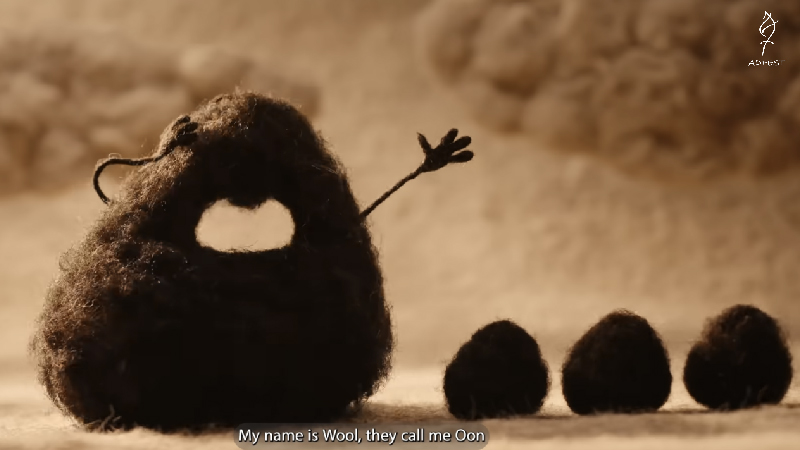
The next "Campaign Shoutout" goes to one of the most beautiful winners of ADFEST 2026, the Film Craft Lotus Grande winner, "Desi Oon." The film for Centre for Pastoralism by Studio Eeksaurus Productions, Mumbai also took home two Film Craft Lotus Golds, one for Production Design and one for Original Music, plus a Bronze in Film Lotus. A six-minute stop-motion film about a forgotten material, made almost entirely from that same material, turned out to be one of the festival's most awarded pieces of craft.
India has the third-largest sheep population in the world. And yet its wool industry runs mostly on imports. Indigenous wool, the kind shepherds across the Deccan plateau have spun for generations, often gets thrown away as waste while synthetic and foreign alternatives fill the shelves. The shepherds who once supported a whole economy are now barely part of one.
That decline is the subject of Desi Oon. Centre for Pastoralism, a non-profit working to keep pastoralist life alive, commissioned the film as an awareness piece. What Studio Eeksaurus made for them wasn't a documentary or a fundraising appeal. It was something warmer, and harder to forget.
Most films about a disappearing craft would simply film the craft. Desi Oon did something different. It made the wool itself the narrator. The film is voiced as if the material is telling its own story, remembering a time when it was treated as something precious, and noticing how quietly it has been set aside.
That idea could have stayed a nice thought on paper. What lifts it is the production choice underneath. The film was animated using real Deccani wool. The thing the film is about is also the thing the film is made of. So when the wool on screen gathers itself into a sheep, a shepherd, a stretch of land, the audience is watching the actual material act out its own history.
That is a rare thing to pull off. Animation almost always turns its subject into something else, into clay, pixels, drawings, or puppets. Desi Oon refused the translation. The subject stayed itself the whole way through. And that choice does the film's job for it. A film arguing that this wool matters, made entirely of that wool, has half-won the argument before the first word is spoken.
There was a good reason nobody had built a film quite this way before. Wool is genuinely difficult to animate. It absorbs moisture, it shifts under lighting, and it doesn't hold a steady shape from one frame to the next. Stop-motion depends on small, controlled changes between frames, and wool resists exactly that kind of control.
No pipeline existed for this. Neither the director nor the team had animated with wool before. So they built the method from scratch, working through felting, layering, and lighting tests until the material became stable enough to perform. The studio ran two setups side by side in a compact space, and much of the animation was handled by a student team with no prior stop-motion experience.
The constraints could easily have held the film back. Instead they shaped how it looks. The gentle imperfection of handmade wool animation, the softness, the visible fibre, became the film's signature. That is what the Production Design Gold rewards. The look of Desi Oon couldn't have come from a cleaner, better-funded process. It came from people solving a material problem with their hands.
There's something here worth taking to the next brief. Desi Oon points at a different question, asked earlier: what could this be made of, so the craft carries the meaning on its own? Get that right and the work makes its case before the first line of script.
A film about a dying industry carries an obvious risk. It can slip into a lecture, and a lecture rarely travels far. Desi Oon avoided that mostly through its music, which earned the film its second Gold.
Instead of scoring the film with mood-setting strings, the team built the soundtrack from the folk music of the Deccani shepherds themselves. The melodies follow traditional shepherd song structures. The score uses native singing styles from the region, performed on live folk instruments, some of them rare. For the pastoralist audience the film is partly made for, the music is instantly recognisable. It sounds like home.
That choice keeps the film warm where it could have been heavy. A sing-along quality carries the message further than a serious voiceover would. Desi Oon treats the shepherds' culture as the language of the film, not just its subject.
Film Craft Lotus rewards the how behind the what, the execution rather than the idea on its own. Desi Oon earned its Grande there because every craft layer points at the same thing. Wool animated with wool. Music built from the community's own songs. The medium was never just how this story got told. It was the reason the story holds.
And in the final frames, the wool settles back into a soft, unspun heap, looking less like an ending and more like something waiting to be picked up again.
Stay tuned for more Campaign Shoutouts from ADFEST!