


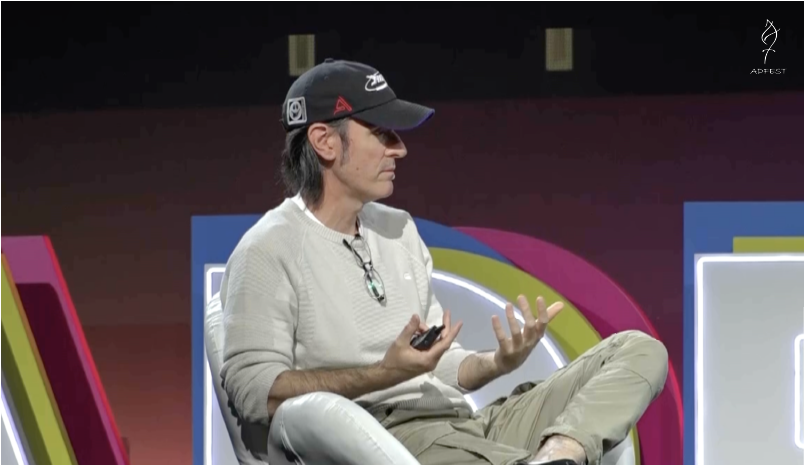
At ADFEST 2026, a four-person panel made the case that feeling — the thing every brief is chasing and nobody is measuring — should be measured. Chris Gurney, Co-Founder and Chief Creative & Innovation Officer at Crisp Group, moderated the session “Feeling Is the New KPI”. He was joined by Director Sam Koay of Koay Films, Vittorio Badini Confalonieri of Benetone Films, and Seiya Matsumiya of Black Cat White Cat Music.
The panel walked through the regional Toyota Advantage campaign to illustrate and opened with a list everyone in the room recognised. Clicks. Views. Engagement. Conversion. These are the things the industry measures. The thing it rarely measures, Chris pointed out, is the one thing every brief is actually asking for. Feeling.
Vittorio sharpened it. Most work today is built to talk to the algorithm rather than to the people behind it, even though the thumbs scrolling past in two seconds belong to the same humans who will sit with a story that genuinely moves them.
The Toyota Advantage campaign was an attempt to build for the kind of attention people give a story when something in it actually reaches them. Three films, each anchored to a Toyota brand pillar — Diversification, Service Excellence, and Quality, Durability & Reliability. Three different stories, three different emotional textures, one regional campaign.
The working principle the panel landed on was simple. AI accelerates exploration. Humans anchor the soul of the work. In practice, the split looked like this:
AI supported: rapid idea exploration, VO rhythm tests, visual and musical mood sketches, pre-visualisation.
Humans defined: tone and story arc, cultural nuance, emotional intention, performance direction.
It's the second list that decides whether a film lands.
Sam talked through one decision inside the Diversification film. A community event scene where the Toyota Hilux is being used to cook and hand out food. At the end of the sequence, a little girl arrives late, and the hero takes the last bit of food meant for himself and gives it to her. Sam fought for that scene. Chris backed him. It took more time and more crew to shoot, and no algorithm would have argued for it. That moment came from two of the four Human-defined factors at work in a single shot: emotional intention and performance direction.
The Quality, Durability & Reliability film started from the other side of the same framework. AI did the heavier lifting first — pre-visualisation and mood sketching, testing how the film could move between live action, archival TV footage, and generated frames before anyone was on set. Once the rhythm was locked, humans took over for tone, cultural nuance, and the performance that had to land on camera.
Then came the proof. The campaign ran regionally with Google as a media partner, and the panel was given measurement back on which of the three films performed best. All three scored well. The Diversification film — the most traditionally emotional, the one with the little girl and the food — scored highest. The most human cut won the measurement.
Which makes sense if you take Saya's point seriously. AI is pure logic. It has no intuition, and no gut sense for when something is right or wrong. That gut sense is what feeling actually is, and the Toyota measurement suggests it can now be tracked alongside the metrics that already are.
Vittorio closed with the bigger reframe. The industry used to compete on execution. AI has flattened execution. What's left is point of view, and whether the work makes a person feel anything when it lands.
So if feeling is a KPI, is it time to add it to campaign evaluation?